
Checking Criminal History in Wayne County
No single search contains every Wayne County criminal record. Start with the Circuit and General Sessions Clerk for a felony, misdemeanor, or preliminary matter. A city citation may remain with the clerk in Clifton, Waynesboro, or Collinwood. The jail roster answers a different question about recent local custody, while the Tennessee Bureau of Investigation holds fingerprint-supported statewide history. Tennessee appellate C-Track begins to matter only after an appeal.
A precise search begins with a full name, spelling variants, an approximate year, and a case or booking number when known. Date of birth can help an official office distinguish similar names, but the Wayne trial clerk has not published an online search form. Ask about public status, archives, inspection, copies, certification, mail service, payment, and current fees before making a trip.
- Identify whether the event began with a county agency or one of Wayne County's three city police departments.
- Ask the correct court clerk for the filed charge, docket, disposition, and sentence.
- Check the county roster or booking desk for recent local custody.
- Use TORIS when a statewide Tennessee name-based history is needed.
- Use FOIL only for felony custody or supervision connected with the Tennessee Department of Correction.
Wayne County Criminal Justice Center
The main local records hub is the Wayne County Criminal Justice Center, 1016 Andrew Jackson Drive, Waynesboro. The sheriff and jail operate on the first floor. The Circuit Court Clerk's suite is identified as Suite 202, and the General Sessions and Juvenile Judge office is on the second floor. This concentration is useful, yet each office remains the custodian of its own work.
The official law and justice page shows how those offices share one building without merging their files. A court judgment belongs with the clerk. An arrest narrative belongs with the agency that wrote it. A booking record belongs with the jail. Questions about a prosecution or an expungement packet may go to the district attorney at a separate Highway 64 East office.
The county's Justice Center page shows the local office layout.
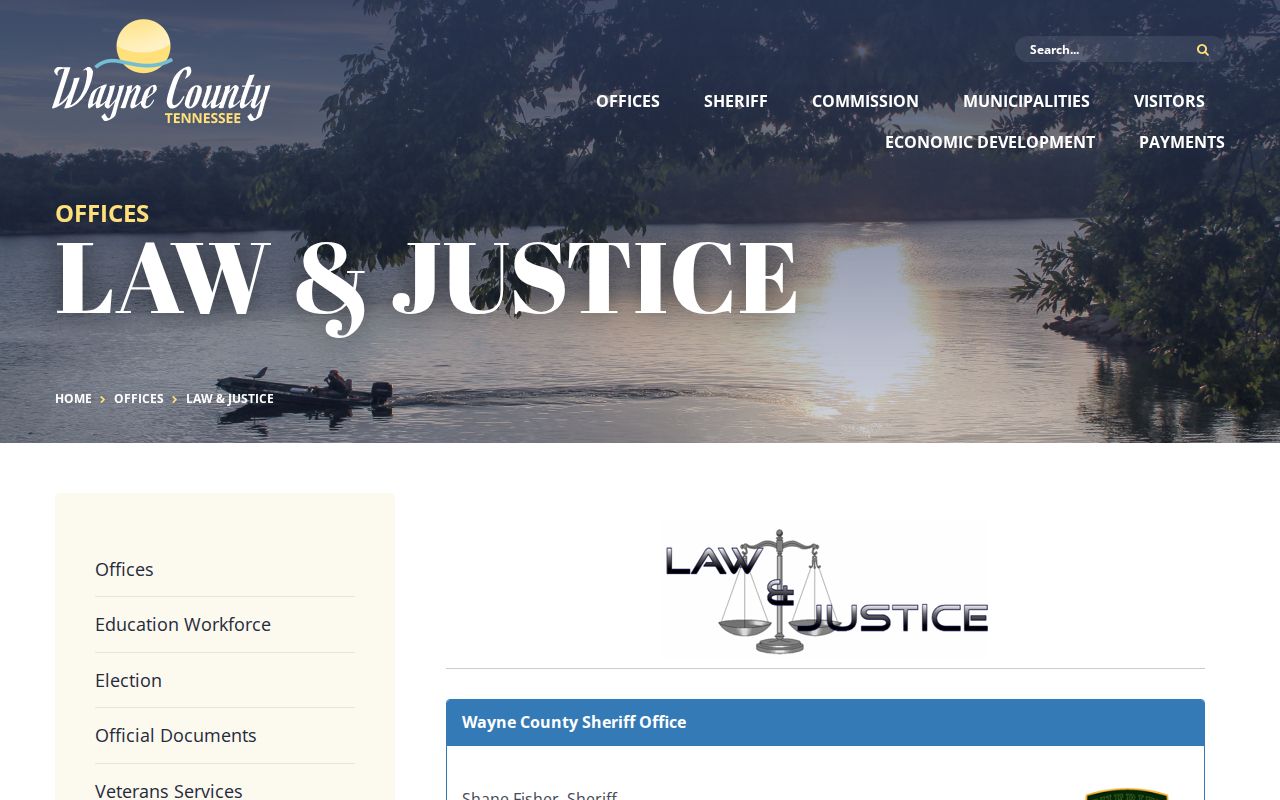
That layout is why a Wayne County criminal record request should name both the record and the office, even when two counters share an address.
Tennessee Official Background Checks
The Tennessee Bureau of Investigation is the state criminal-history repository. Its public product, Tennessee Open Records Information Services, is presented through TN FlexCheck. TORIS is a $29, nonrefundable name check of Tennessee misdemeanor and felony arrest information created from fingerprints submitted by arresting agencies. It is not a national search, an FBI check, or a replacement for a Wayne County court file.
Any requester may order the name-based product. The online result depends on accurate identifying details and does not return aliases in a matched history. Juvenile information is excluded unless a juvenile was transferred for adult prosecution under Tennessee law. For an identity or accuracy dispute, TBI directs the subject to submit law-enforcement fingerprints, a letter, and a $24 cashier's check or money order. IdentoGO by IDEMIA is the scheduled channel when a Tennessee program requires an authorized TBI or FBI fingerprint check.
| Official channel | Scope | Published cost |
|---|---|---|
| TORIS | Tennessee name-based, fingerprint-supported history | $29 |
| TORIS dispute | Identity or accuracy review with law-enforcement fingerprints | $24 |
| FBI Identity History Summary | One's own federal fingerprint history | $18 direct |
The official TORIS interface displays the Tennessee request route.
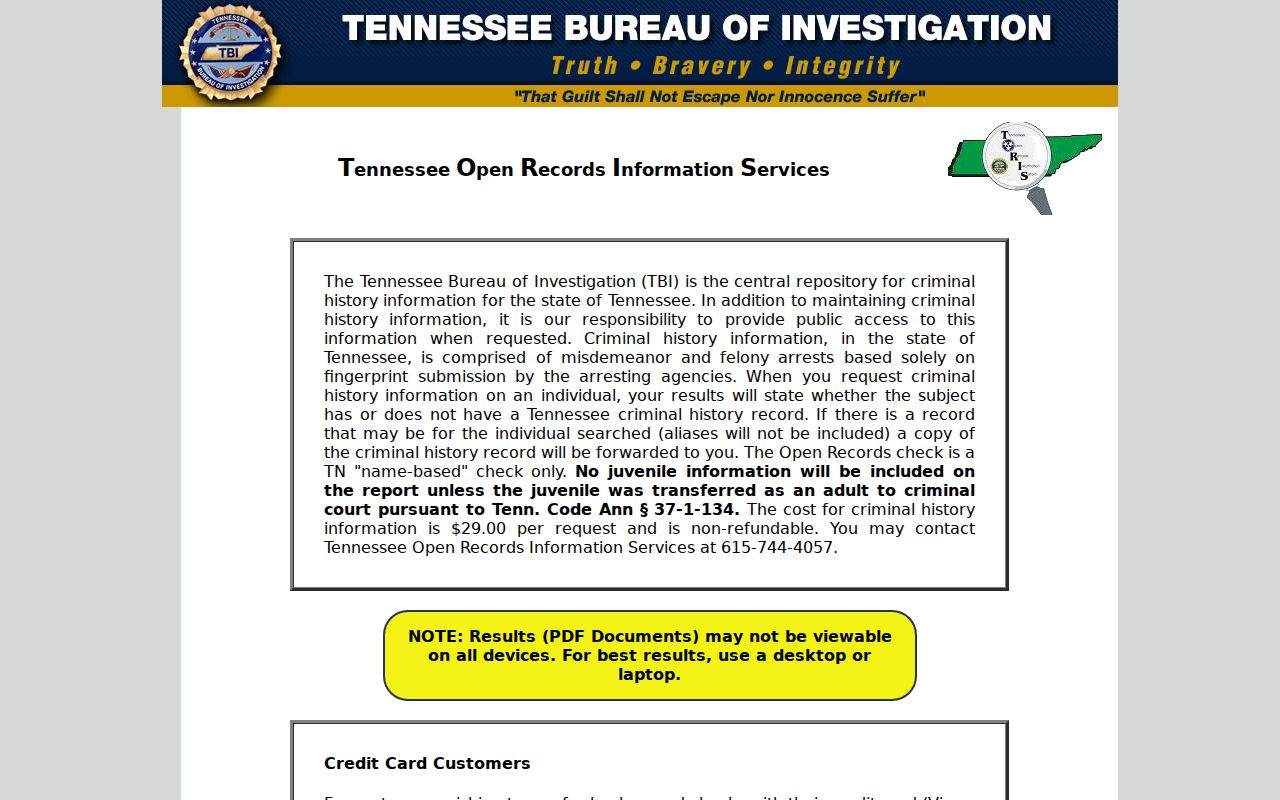
The screen is a state repository gateway, so a Wayne County searcher still needs the local clerk for the documents behind one prosecution.
Wayne County's Split Record System
Wayne County criminal records divide by purpose. The local clerk preserves what happened in court. The jail records intake and custody. An arresting agency keeps its incident and arrest narrative. TBI organizes fingerprint-linked cycles and dispositions reported from across Tennessee. TDOC later creates prison, probation, or parole data for felony cases within its system.
The contrast matters when records disagree. A booking charge describes the basis recorded at intake. The prosecutor may file a different charge. A clerk's judgment supplies the disposition. TBI may not yet show that result if it has not arrived. Likewise, silence in appellate C-Track says nothing about a trial case because that tool covers the Supreme Court, Court of Appeals, and Court of Criminal Appeals.
The Tennessee Public Case History page visibly limits its scope to appellate records.
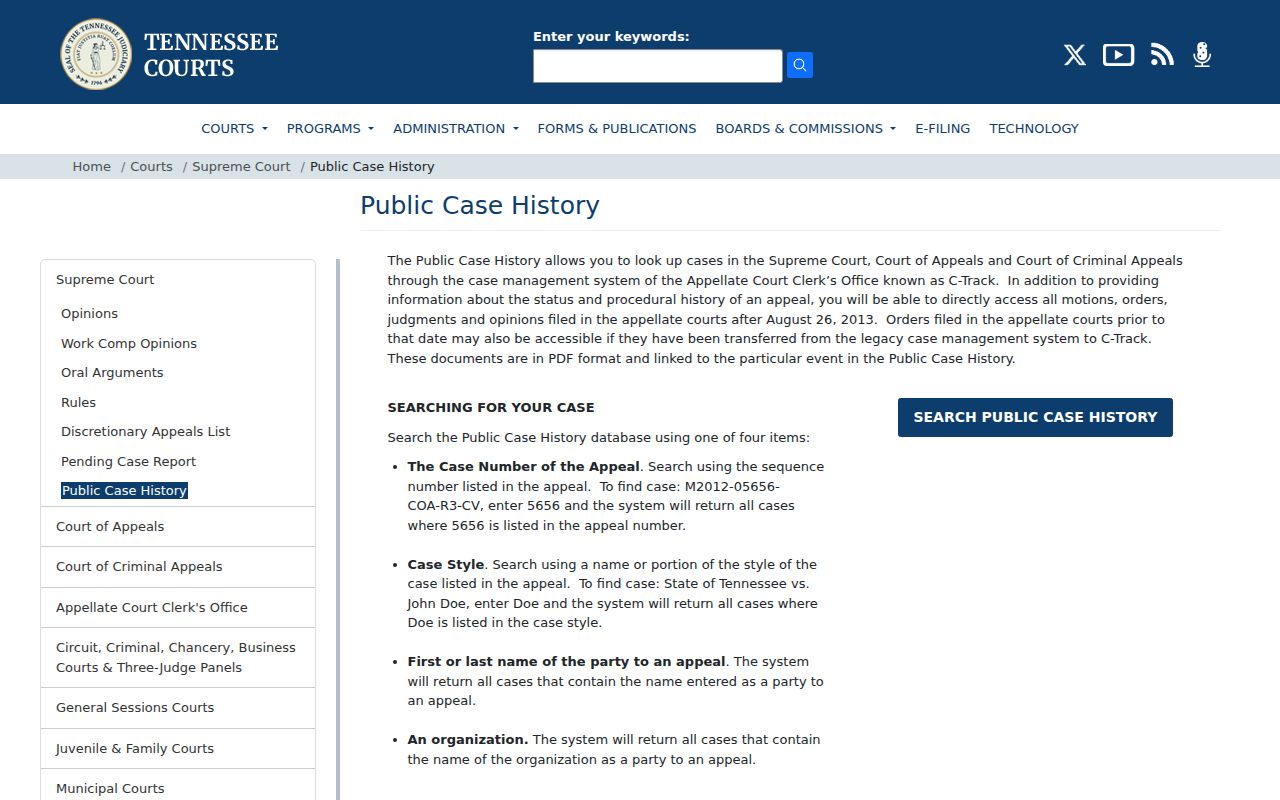
Use it after an appeal, not as proof that Wayne County Circuit or General Sessions has no file.
Criminal Record Types
A Wayne County criminal history search becomes clearer when the record type is named first. An incident report states what an officer observed or was told. A booking entry centers on jail intake. A charging file tracks the prosecution. A repository history groups arrest cycles and reported results. These are related, but they are not interchangeable.
- Incident and arrest reports: request them from the Wayne County Sheriff's Office, the relevant city police department, or the Tennessee Highway Patrol.
- Booking records: use the Wayne County Jail gateway, recent roster, or booking desk.
- Court files: ask the Circuit and General Sessions Clerk or the correct municipal clerk.
- Repository history: order a TORIS name check from TBI.
- Custody and supervision: separate Wayne jail data from TDOC FOIL information.
Warrants and registry listings also follow distinct routes. No official Wayne warrant portal was found. The Tennessee Sex Offender Registry is a TBI system, with local reporting or noncompliance questions routed to law enforcement.
Wayne County Custody Record Boundaries
The Wayne County roster and TDOC's Felony Offender Information Lookup answer different custody questions. The roster is the local route for recent, pretrial, or county-jail custody. FOIL concerns people currently or formerly in Tennessee felony custody or supervision. It may show a photograph, offense, sentence, location, release details, parole hearing information, and whether the status is incarcerated, probation, parole, or inactive.
Tennessee probation is court-ordered community supervision administered by TDOC. Parole is conditional release authorized by the Tennessee Board of Parole, with TDOC supervising the conditions. The Wayne County court file shows the sentence and any later violation or revocation filing. VINELink is the separate notification route for custody and release changes. Detailed supervision files should not be treated as a public dossier.
For a local jail question, call the booking desk. For a felony supervision record, start with the official TDOC FOIL page. The published Columbia probation and parole field-office contact should be verified before travel because the state source does not confirm every Wayne assignment.
Wayne County Criminal Record Flow
A qualifying Wayne County misdemeanor or felony booking produces a fingerprint-supported arrest event for TBI. The jail separately creates custody, charge-at-booking, bond, and related booking data. Prosecutors and courts then create complaints, indictments, motions, hearings, judgments, sentences, and financial entries. The clerk reports the disposition, and TBI's Criminal Records Unit enters final dispositions, diversions, and signed expungement orders.
Agency report → arrest and fingerprints → Wayne County booking → charging decision → court disposition → TBI update → TDOC record when applicable.
This flow explains common gaps. An event may lack fingerprints. A court outcome may not yet have reached the repository. A name query may confuse two people. The best correction route starts with the source of the disputed fact, then follows the record downstream.
Inside a Wayne County Criminal Record
A repository history is usually organized around identity, arrest cycles, charges, dispositions, and later custody or supervision. A court case is organized around events and filed documents. A booking entry is organized around custody. Reading the labels in context prevents an allegation from being mistaken for a final result.
| Name and identifiers | Details used to distinguish one subject from another; public products may redact sensitive identifiers. |
|---|---|
| Arrest or booking | The agency, date, intake event, initial charge, custody, and bond information when that source publishes it. |
| Charges | Allegations at arrest or charges later filed by the prosecutor, which may differ. |
| Disposition | The result, such as conviction, acquittal, dismissal, diversion, or nolle prosequi. |
| Sentence | The court-ordered consequence after a judgment. |
| Custody or supervision | County jail, TDOC prison, probation, parole, or inactive status in the system that maintains it. |
A “cleared” offense in an agency statistics table is not the same as a conviction. It is a crime-reporting measure. The court disposition remains the best source for the outcome of a particular prosecution.
Wayne County Booking Record Fallbacks
The official Wayne County inmate gateway links to a Southern Software booking search for recent local custody. During research, anti-automation controls prevented an honest inventory of its fields and result layout. Do not assume it accepts a date of birth or booking number, and do not infer that every released person remains visible.
When the roster is unavailable, call the Wayne County Jail booking desk at 931-722-3615, option 1. Material not shown may also be sought through the county public-record process, subject to redactions and confidentiality rules. The sheriff's site warns that policy, law, emergencies, and maintenance can affect availability.
The officially linked Wayne booking interface shows the vendor-hosted entry point.
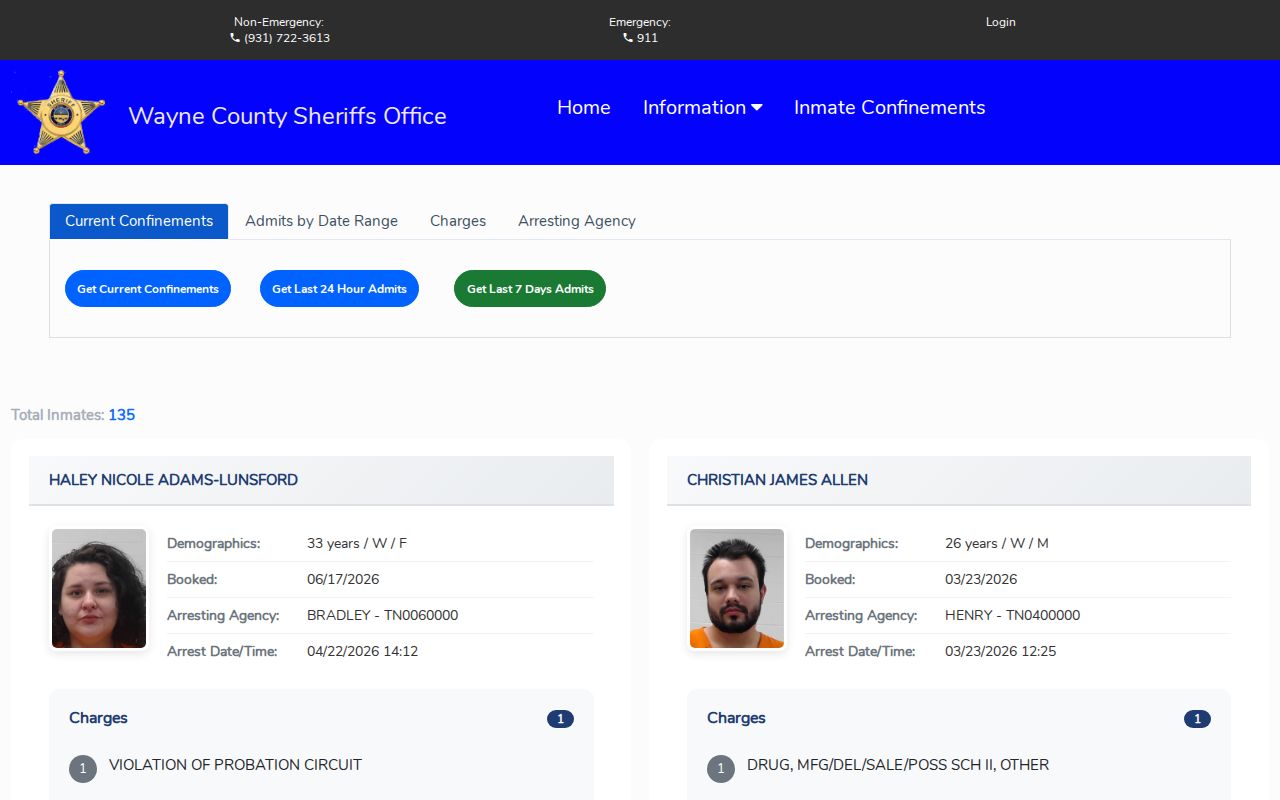
That roster concerns county custody, while TDOC FOIL concerns felony offenders in state custody or community supervision.
Public Access Laws in Tennessee
The Tennessee Public Records Act gives an inspection framework, but it does not erase statutory exceptions. Tennessee Supreme Court Rule 34 applies access rules to trial-court records and protects sealed material, judicial drafts, deliberative notes, internal case-management information, and records whose release would frustrate judicial work. A narrow request to the actual custodian is more useful than asking one office for “everything.”
Key Tennessee authorities:
TCA §10-7-503 establishes the public-record inspection framework reflected in Wayne County's policy documents.
TCA §10-7-504 preserves confidential categories and access exceptions.
Supreme Court Rule 34 governs access to Tennessee court records.
TCA §37-1-134 addresses juvenile transfer for adult prosecution and the TORIS exception.
TCA §40-32-101 provides the main Tennessee expunction authority.
Active investigations, juvenile data, victim information, medical details, and sealed matters may be withheld or redacted. Public access means access to records the law makes public, not unrestricted access to every fact an agency holds.
Wayne County Public Records Documents
The Wayne County Document Center is the formal fallback when no direct sheriff portal supplies a record. Its Public Records section lists a 2017 policy, request form, response form, estimate and invoice, schedule of reasonable charges, and Safe Harbor Policy. The legacy file redirects could not be inspected during research, so no form field, fee, identity rule, or response time should be assumed.
Call the county to identify the current Public Records Request Coordinator and obtain a live copy of the form. A useful description states the kind of record, date, place, agency, report or booking number if known, and preferred inspection or copy format. Those are practical identifiers, not claimed mandatory fields.
Wayne County Sheriff's Office
1016 Andrew Jackson Drive
Waynesboro, TN 38485
931-722-3615
The official sheriff page identifies the county law-enforcement office and main contact.

The sheriff is the starting custodian for sheriff-created reports, not for city police reports or court judgments.
Wayne County Police Record Routes
Police reports remain agency by agency. The Wayne County Sheriff's Office uses the county public-record route. Waynesboro directs readers to its Public Square police office and publishes an accident-report-copy tab, although no separate online request form was available for inspection. Clifton routes requests through its police department and City Hall. Collinwood says its police office is not regularly staffed and directs unanswered nonemergency calls to county dispatch.
Ask the agency that created the report for the incident narrative. Give the date, place, report number, and involved role when known, then ask about current fees, identification, redactions, format, and timing. Active investigations, juveniles, protected victims, medical information, and personal identifiers can limit release. The filed court case must still be obtained from the proper clerk.
Crash reports have another route. Tennessee's PurchaseTNCrash portal sells an electronic PDF for $10. Its search instructions and timing apply to crash records, not to all arrest or incident reports.
Sealed, Expunged, and Restricted Records
Tennessee uses “expungement” and the statutory noun “expunction.” TBI describes qualifying relief as deletion, not merely hiding a record behind a seal. The process begins in the court and county connected with the arrest or prosecution. A dismissal does not justify assuming that all related systems updated on their own.
For an eligible non-conviction or conviction, ask the Wayne County clerk or district attorney for the current petition and order route. TBI's older FAQ lists a $100 clerk fee for qualifying conviction relief and states that some non-conviction relief can be without cost, but the current amount should be verified. The signed order may need distribution to the arresting agency, jail, TBI, FBI, and TDOC when relevant.
After relief, check that each custodian received and processed the order. If cleared information remains public, send the signed order to the source displaying it. Juvenile, victim, protected, sealed, or active-investigation material may be unavailable for reasons separate from expungement.
Wayne County Warrant Record Checks
No official Wayne County warrant search, app, active list, or most-wanted page was found. The county booking roster is not a warrant search. Ask the sheriff or dispatch about sheriff-held information, contact the Circuit or General Sessions Clerk for a county warrant or capias tied to a case, and contact the correct city clerk for a municipal bench-warrant issue.
An arrest warrant authorizes custody based on probable cause. A bench warrant or capias often follows a failure to appear or comply. A search warrant authorizes a search and may stay sealed during an investigation. A record may contain the issuing court, case or warrant number, reason, date, status, and bond, but no Wayne County sample was available to confirm a local field set.
For one's own possible warrant, obtain direct instructions from the issuing court or sheriff before appearing. No Wayne amnesty event, dedicated warrant line, statewide public e-warrant search, or published payment process was verified.
Wayne County Recovery Court Records
Wayne County belongs to Tennessee's 22nd Judicial District with Giles, Lawrence, and Maury counties. The district's Recovery Court serves all four counties at the Circuit level. The state behavioral-health directory lists Judge Chris Sockwell and program contact Tamara Robinson at South Central Human Resource Agency in Lawrenceburg.
Recovery Court is a named local program, not a separate public case-search portal. The clerk's case file remains the source for public docket events and the court's disposition, subject to access limits. Program treatment or other protected details should not be inferred from a public docket. A fifth Circuit division was added in 2023, which concerns court structure rather than a new records database.
Wayne County Criminal Records by City
Wayne County has exactly three incorporated cities. Each has a police department and municipal court, so a city report or citation may stay at a city counter even though felony and county-level matters move through Circuit or General Sessions. Official 2025 certified populations place Clifton first, Waynesboro second, and Collinwood third.
Clifton Criminal Records
Certified population 2,651. Police and Municipal Court share the City Hall location on Main Street.
Waynesboro Criminal Records
Certified population 2,317. Police records and city citations begin at Public Square.
Collinwood Criminal Records
Certified population 898. Telephone and City Hall routes matter because the police office is not regularly staffed.
A city citation payment page is not a criminal case search. For a filed felony, misdemeanor, or preliminary case, return to the Wayne County clerk even when the event began inside city limits.